
Overview
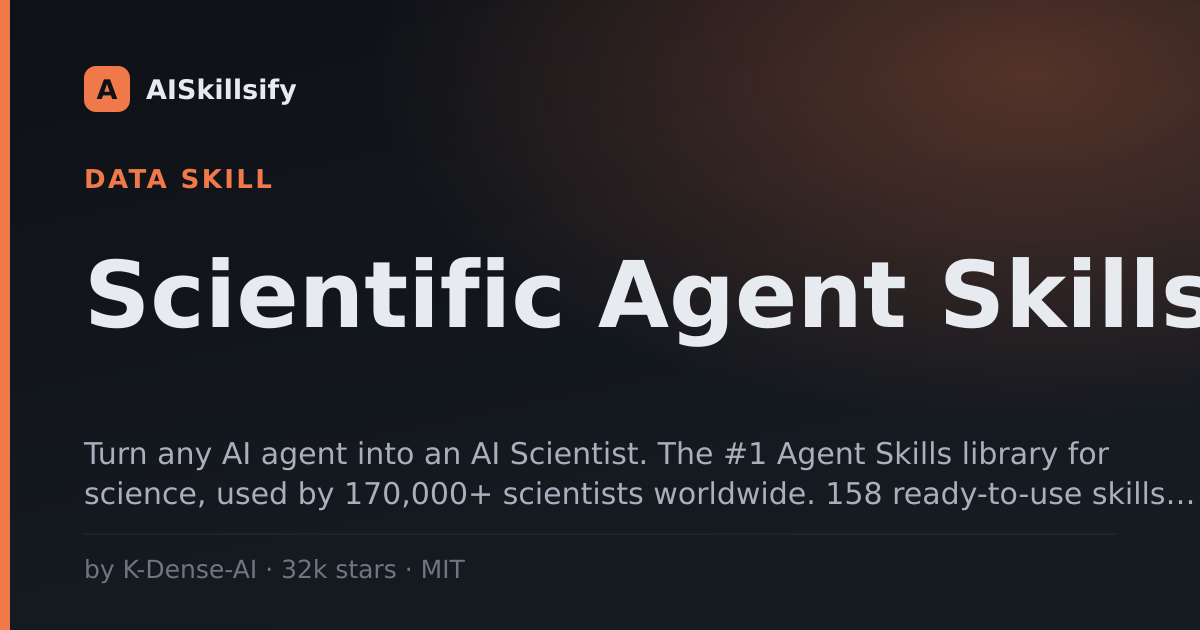
Scientific Agent Skills is an open-source data skill for Claude Code, Cursor, Codex, and Antigravity, published by K-Dense-AI. Its author describes it as: “Turn any AI agent into an AI Scientist. The #1 Agent Skills library for science, used by 170,000+ scientists worldwide. 158 ready-to-use skills plus 100+ scientific databases covering biology, chemistry, medicine, and…”. The project has 32k stars on GitHub and is available under the MIT license. Add it to your setup with `git clone https://github.com/K-Dense-AI/scientific-agent-skills ~/.claude/skills/scientific-agent-skills`.
Installation
Add Scientific Agent Skills to your agent with:
git clone https://github.com/K-Dense-AI/scientific-agent-skills ~/.claude/skills/scientific-agent-skillsReview a skill’s source before installing it — skills can instruct your agent to run commands. This command comes from the skill’s public repository, which is the source of truth for setup steps. New to skills? Read how to install Claude Code skills.
Supported agents
- Claude Code — named in the skill.md
- Codex — named in the skill.md
- Cursor — named in the skill.md
- Antigravity — named in the skill.md
License
Scientific Agent Skills is published under the MIT license.
Strengths
- Clear MIT license — safe to read and adapt within its terms
- Ships in K-Dense-AI/scientific-agent-skills, an established project with 32,167 GitHub stars
- Works with Claude Code, Codex, Cursor, Antigravity
- Actively maintained — repository updated in the last 90 days
Author
Topics
Frequently asked questions
- What does Scientific Agent Skills do?
- Turn any AI agent into an AI Scientist. The #1 Agent Skills library for science, used by 170,000+ scientists worldwide. 158 ready-to-use skills plus 100+ scientific databases covering biology, chemistry, medicine, and drug discovery. Compatible with Cursor, Claude Code, Codex, Pi, Antigravity, and the open Agent Skills standard.
- How do I install Scientific Agent Skills?
- Run git clone https://github.com/K-Dense-AI/scientific-agent-skills ~/.claude/skills/scientific-agent-skills in your agent, then reload your skills. Review the source at https://github.com/K-Dense-AI/scientific-agent-skills before installing.
- Is Scientific Agent Skills free to use?
- Yes. Scientific Agent Skills is free and open source under the MIT license, so you can read, run, and adapt it within that license's terms.
- Which agents does Scientific Agent Skills work with?
- Scientific Agent Skills lists Claude Code, Codex, Cursor, and Antigravity — named in its SKILL.md, its plugin marketplace or its repository topics. Skills use the portable SKILL.md format, so other agents that read that format may load it too.
- Where does Scientific Agent Skills come from?
- Scientific Agent Skills ships inside K-Dense-AI/scientific-agent-skills, a repository that contains 42 catalogued skills in total. The repository's 32,167 GitHub stars apply to that whole collection, not to this skill on its own.