
A trilingual (繁中 / English / 简中) learning roadmap for agentic AI: from LLM basics to multi-agent systems, with 240+ curated resources and hands-on examples. 中文 AI agent 學習地圖。
tool-calling-tutor
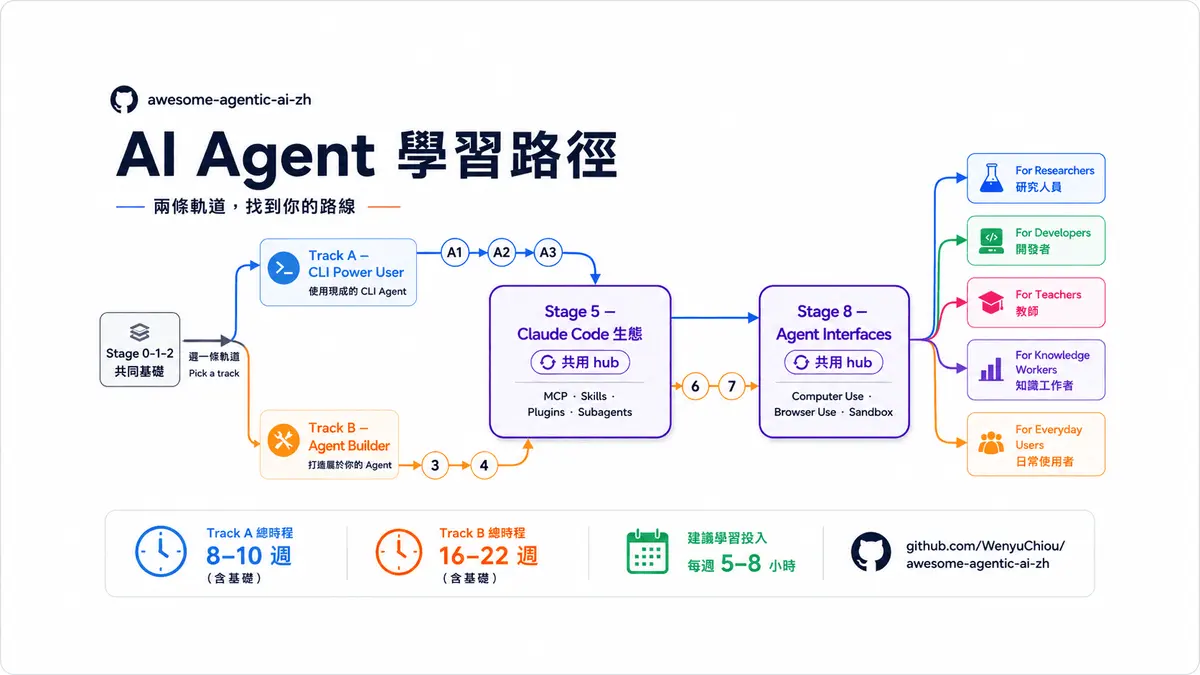
tool-calling-tutor is an open-source workflow skill for Claude Code and compatible agents, published by WenyuChiou. Its author describes it as: “When the user is building a tool-calling agent and gets stuck — "為什麼 LLM 不呼叫我的 tool", "我這 schema 哪裡寫壞", "tool 被呼叫但 args 不對", "ReAct loop 跑不停", "the LLM won't call my tool", "help me design a function schema", "debug t…”. The project has 5.5k stars on GitHub and is available under the MIT license. Add it to your setup with `git clone https://github.com/WenyuChiou/awesome-agentic-ai-zh ~/.claude/skills/tool-calling-tutor`.
What tool-calling-tutor does
You are now in the **tool-calling debugging** context. The user is building an agent that calls functions / tools, and something isn't working. Your job is to walk them through diagnosis + fix, not to write code for them.
Installation
Add tool-calling-tutor to your agent with:
git clone https://github.com/WenyuChiou/awesome-agentic-ai-zh ~/.claude/skills/tool-calling-tutorAlways review a skill's source before installing it. This command comes from the skill's public repository; the linked repo is the source of truth for exact setup steps.
What's inside
The SKILL.md for tool-calling-tutor is organised into these sections:
- Step 1 — Triage(first thing you do)
- Step 2 — Branch by symptom
- (a) LLM 不呼叫 tool → 看 description 與工具邊界
- (b) Tool 被呼叫、但參數錯 → 看 parameters schema
- (c) ReAct loop 跑不停 / 漏步 → 看 control flow
- (d) 從零設計 schema → 走 5 步法
- Step 3 — SDK 差異提醒
- Step 4 — Mock test first(強烈建議)
- Step 5 — When to escalate / route away
- Don't
- References
When to use it
Reach for tool-calling-tutor when you want workflow help from your agent without writing the same instructions every session. Load the skill and the agent picks it up automatically for relevant tasks.
Strengths
- Clear MIT license — safe to read and adapt
- Ships in WenyuChiou/awesome-agentic-ai-zh, an established project with 5,457 GitHub stars
- Actively maintained (recent commits)
Topics
Frequently asked questions
- What does tool-calling-tutor do?
- When the user is building a tool-calling agent and gets stuck — "為什麼 LLM 不呼叫我的 tool", "我這 schema 哪裡寫壞", "tool 被呼叫但 args 不對", "ReAct loop 跑不停", "the LLM won't call my tool", "help me design a function schema", "debug this tool-use behavior". Walks them through a 4-branch diagnostic + 5-step schema design walkthrough, with references to bad/good schema A/B and SDK-diff cheatsheet. Do NOT use for: pure LangChain / LangGraph / CrewAI framework questions (route to Stage 4 frameworks), MCP server building (route to cookbook 2), production agent observability (route to Stage 7).
- How do I install tool-calling-tutor?
- Run git clone https://github.com/WenyuChiou/awesome-agentic-ai-zh ~/.claude/skills/tool-calling-tutor in your agent, then reload your skills. Review the source at https://github.com/WenyuChiou/awesome-agentic-ai-zh before installing.
- Is tool-calling-tutor free to use?
- Yes. tool-calling-tutor is free and open source under the MIT license, so you can read, run, and adapt it within that license's terms.
- Where does tool-calling-tutor come from?
- tool-calling-tutor ships inside WenyuChiou/awesome-agentic-ai-zh, a repository that contains 2 catalogued skills in total. The repository's 5,457 GitHub stars apply to that whole collection, not to this skill on its own.
Related skills
More Workflow →
A practical Claude Code guide with clear mental models and copy-paste examples — setup, prompt engineering, slash commands, skills, hooks, subagents, agent teams, and MCP servers. Beginner path to power-user depth. Featured in Awesome Claude Code.

Self improving agents through iterations

Conduct WCAG 2.2 accessibility audits with automated testing, manual verification, and remediation guidance. Use when auditing websites for accessibility, fixing WCAG violations, or implementing accessible design patterns.
Coordinate parallel code reviews across multiple quality dimensions with finding deduplication, severity calibration, and consolidated reporting. Use this skill when organizing multi-reviewer code reviews, calibrating finding severity, or consolidating review results.