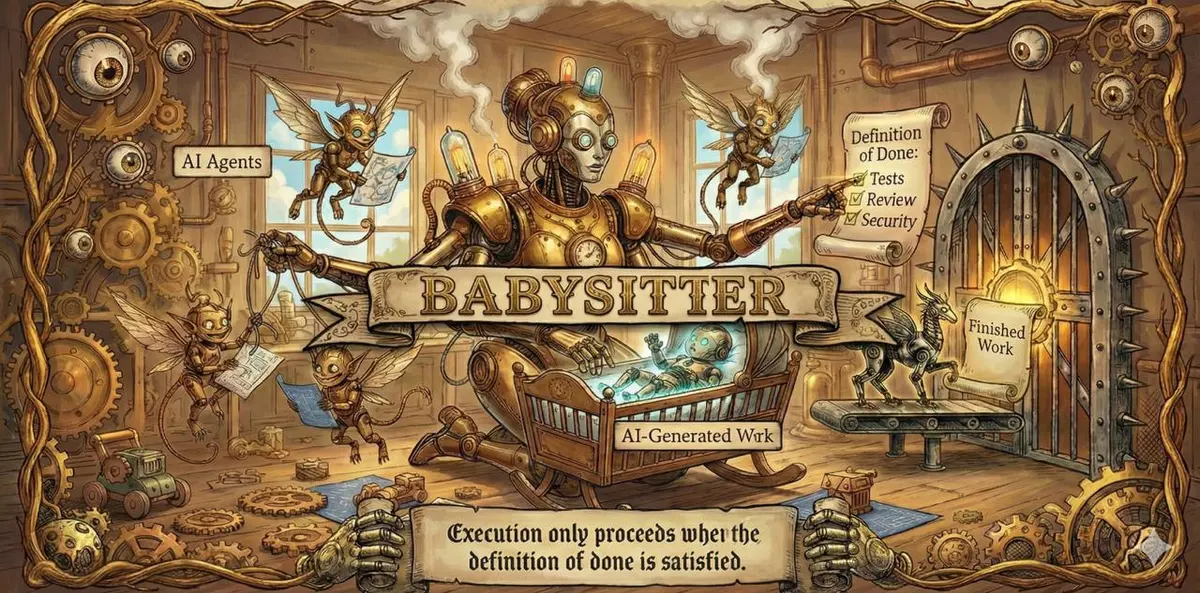
Babysitter

Babysitter enforces obedience on agentic workforces and enables them to manage extremely complex tasks and workflows through deterministic, hallucination-free self-orchestration

by a5c-ai 1.6k GitHub stars MIT Updated Jul 25, 2026
Babysitter skill by a5c-ai
Social preview for a5c-ai/babysitter

Overview

Babysitter is an open-source workflow skill for Claude Code and Codex, published by a5c-ai. Its author describes it as: “Babysitter enforces obedience on agentic workforces and enables them to manage extremely complex tasks and workflows through deterministic, hallucination-free self-orchestration”. The project has 1.6k stars on GitHub and is available under the MIT license. Add it to your setup with `/plugin marketplace add a5c-ai/babysitter`.

Installation

Add Babysitter to your agent with:

/plugin marketplace add a5c-ai/babysitter

Review a skill’s source before installing it — skills can instruct your agent to run commands. This command comes from the skill’s public repository, which is the source of truth for setup steps. New to skills? Read how to install Claude Code skills.

Supported agents

License

Babysitter is published under the MIT license.

Strengths

  • Clear MIT license — safe to read and adapt within its terms
  • Established project with 1,611 GitHub stars
  • Works with Claude Code, Codex
  • Actively maintained — repository updated in the last 90 days

Author

a5c-ai 1 skill in the catalog · GitHub profile ↗

Topics

Need a skill like this, tailored to your team?Build a custom skill →

Frequently asked questions

What does Babysitter do?
Babysitter enforces obedience on agentic workforces and enables them to manage extremely complex tasks and workflows through deterministic, hallucination-free self-orchestration
How do I install Babysitter?
Run /plugin marketplace add a5c-ai/babysitter in your agent, then reload your skills. Review the source at https://github.com/a5c-ai/babysitter before installing.
Is Babysitter free to use?
Yes. Babysitter is free and open source under the MIT license, so you can read, run, and adapt it within that license's terms.
Which agents does Babysitter work with?
Babysitter lists Claude Code and Codex — named in its SKILL.md, its plugin marketplace or its repository topics. Skills use the portable SKILL.md format, so other agents that read that format may load it too.

When you can't trust yourself with your code base, trust Arbiter.

Claude CodeCodex
137 GitHub stars AGPL-3.0-only Updated Jul 30, 2026 Free

Use when the user asks to design a multi-agent system, pick an orchestration pattern (supervisor/swarm/pipeline), generate tool schemas for agents, or evaluate agent execution logs for cost, latency, and failure bottlenecks. Examples: 'design an agent architecture for research automation', 'generate Anthropic tool schemas from these tool descriptions', 'analyze these agent run logs for bottlenecks'. NOT for Claude Code workflow files (use workflow-builder) or single-agent prompt design (use agent-workflow-designer).

Claude CodeCodexCursor+1
25k GitHub stars MIT Updated Aug 17, 2026 Free

Turn any domain folder of skills into a bounded agentic loop: compile a goal into a verifiable task plan, execute tasks with the domain's own tools, verify every task with machine-run checks, retry with caps, escalate to a human when budgets exhaust, and refuse to close until everything is verified or explicitly waived. Use when you want an agent or subagent to pick up a goal and drive it to a verified close across one of this repo's 18 domains ('run this goal through the engineering harness', 'set up an agentic loop for marketing work', 'make the finance domain self-verifying'). NOT for authoring Claude Code Workflow-tool .js scripts (workflow-builder), N-agent tournaments on one task (agenthub), single-file metric optimization (autoresearch-agent), or discovering published loop recipes (loop-library).

Claude CodeCodexCursor+1
25k GitHub stars MIT Updated Aug 17, 2026 Free

Design production-grade multi-agent workflows with clear pattern choice (sequential, parallel, hierarchical), handoff contracts, failure handling, and cost/context controls. Use when architecting a multi-step agent pipeline, choosing between single-agent vs multi-agent approaches, or refactoring an LLM workflow that suffers from context bloat or unreliable handoffs.

Claude CodeCodexCursor+1
25k GitHub stars MIT Updated Aug 17, 2026 Free